Sunday, September 19, 2010

Beaver Sculpture

This piece of sculpture was found as part of a beaver dam near Dried Meat Lake, Alberta. While the artist is using some traditional elements in the overall composition, this work is clearly of the new Second-Growth school of sculpture. It represents the ascendancy of Second-Growth as a style capable of addressing both methodology and ardency.
While recent exhibits in the Eastern Willow style have received some critical discussion, most serious collectors and curators have shifted their focus to Second-Growth. The name stems from an emphasis on using aspen and poplar, two trees that were once derided as "too much work to get to." But the so-called G2 artists have been challenging the dominance of willow. They've moved away from the silty creek beds, away from the saplings that helped launch so many careers in the lowland galleries. By broadening their range of materials, the G2 artists have drawn attention to the more subtle aspects of the new style.
This piece in particular shows the potential of Second-Growth. It represents the most dynamic use of form to come out of Dried Meat Lake in years. The artist has eschewed the typical double-V notches in her cut in order to create a form that is tenuous, vulnerable. There is an unsettling asymmetry to this work, a reminder to audiences that for all their seeming friendliness, standing trees are capable of a devastating kinetic violence. But the artist hasn't made an alarmist political work; you can see the careful placement of her lower incisor marks near the center of the wood. She has balanced the bold, precarious form with subtle embellishments. Because there is little of the upper-incisor in this sculpture, she draws attention to chewing as a deliberate act. This work also typifies the G2 emphasis on sensitivity to grain, an obvious response to Eastern Willow's bulky tooth-work.
Adherents of the Eastern Willow style would do well to take note of this work and other G2 offerings. This Dried Meat Lake sculpture exemplifies a challenge to some traditional ideas about material selection and form. Second-Growth has taken on the task of making sculpture that is both graceful and startling. Many curators and audiences, myself included, think they are succeeding admirably.

Sunday, April 25, 2010

Wasp Gall

It seems like there is no limit to how complex parasitic relationships can become in the natural world. There are some great examples of mutually beneficial relationships (think of the shark and lamprey cruising the seas together) but this wasp gall is certainly not one of them. In this case the arrangement is between a female wasp and a wild rose plant. It is not a happy marriage. The closest human corollary would be rape.
Here's how it works: A female wasp uses her sharp ovipositor (a surprisingly long tube that deposits her eggs) to stab into the stem of the plant. Once the eggs are laid she flies away with no additional parenting duties to perform. Then it gets a little crazy. Instead of simply providing a safe home for the eggs to hatch, her egg packet actually contains a chemical payload that subverts the plant's survival mechanisms. It tricks the plant into diverting it's resources to producing a gall which functions as a home for the larvae as well as a nourishment node. This is not in the rose's best interests at all. Once a gall is produced it takes a disproportionate amount of resources from the plant.
But it gets better. Not only are some animals capable of making completely unrelated species rear their young, but other parasites are adept at using existing galls to provide their young with comfort and ease as well. According to Kaufman's Field Guide to Insects of North America (an amazing resource) when galls are reared in the lab naturalists often find that more than one species of insect will emerge. Consider: larvae eating stolen plant resources only to be eaten in turn by some other insect larvae only to be bird food upon leaving the gall but the bird gets parasites from contact with the gall, etc, etc.
Remember that song from The Lion King The Circle of Life? This is what Elton John should have been singing about; parasites on parasites on parasites. A daisy chain of complex fuckings-over, where even evolving totally effective chemical simulacra to give your young a chance doesn't guarantee success. Make that into a clever ballad and try to sell a soundtrack.

Friday, April 16, 2010

Crab


This crab is one tough MF. And why not? He is a representative of mighty Crustacea. This subphylum has been offering up super-weird armored animals for at least 350 million years. The exoskeleton has proven to be a great adaptation for crabs, especially the ones that spend at least some of their time on land. The exoskeleton provides some protection from predators and it also helps the crab maintain moisture. Lots of crabs live a mostly terrestrial existence but a dried out crab is a dead crab.
OK. So the crab has armor plating, some claws and evolved from a good family. But I also have some firsthand knowledge of this particular crab's never-say-die attitude and Relative Pinchiness. (RP is a standard qualitative field measurement.) When I first grabbed him on the beach in Mexico on a fine moonlit night he pinched me in his dominant claw. I shook him off, cursed him a little. Picked him up again. Got pinched again. I decided that I liked his vim and his moxie. I stuffed him in an empty cigarette pack and carried him back to my hotel room. When Wes and I got back we dumped our crab haul in the sink and grabbed some test tubes from our luggage. We didn't have enough isopropyl alcohol to use for killing and preservation. But we did have a lot of tequila around. It was truly foul stuff, to be sure, and we thought that using it to kill the crabs would serve a dual purpose: it would preserve the crustaceans and it would save us from drinking any more of that cactus-rot. So we dumped the crabs in cups of the stinking amber liquid and retired to the balcony to drink the rest of the bottle.
After 20 minutes we decided that our new specimens were probably ready to be transferred to test tubes. They were not. They were still as pinchy and upset as ever. So we waited a little bit. Went back to the sink and discovered that they were still alive. Wes and I stuffed them into the test tubes, trying to ignore all the frenzied pinching.
Was this cruel? Conventional wisdom and early research traditionally supported the view that an animal like a crab was incapable of feeling pain. This was good news for everyone that wanted to pretend that they were not responsible for a lot of suffering because of their diet and habits. But it turns out that this view may be wrong. Are you surprised? Animals with complex nervous systems having no perception of pain seems a little convenient and far-fetched to me. I offer you some words from Professor Bob Elwood from the School of Biological Sciences at Queen's University, Belfast, whose research into pain led him to use crabs as research subjects.
"The results are consistent with the idea of pain being experienced by these animals."
Researching pain in non-mammals gets pretty complex, introducing all sorts of thorny biological and philosophical questions to deal with, so this quote shouldn't be read as fact. It is offered here as something to think about, Wes Hunting, the next time you, Wes Hunting, kill animals in such an unreasonable way for such spurious reasons, Wes Hunting.

Monday, April 12, 2010

Millipede

This millipede was found grazing on dead leaves in Pennsylvania. Unlike other many-legged arthropods like the centipedes, millipedes are slow moving herbivores. When they're bothered they are more likely to roll into a ball and hope you go away than to attempt an escape. A bite is really unlikely.
But if you enjoy the taste of millipede (and who doesn't?) be warned: some millipedes are capable of venting hydrogen cyanide through gaps in their chitinous exterior. Yup. Brewing and emitting poisonous vapours. For a human this is no big deal. It causes irritation, some discoloration of the skin. But to an ant or bird the gas would be a major deterrent. It's not surprising that millipedes have evolved some truly gnarly ways to defend themselves, since scientists believe that they were one of the first types of land creatures. That's a lot of time to evolve even the most outlandish and complex physiology.
Is this millipede that Wes and I caught capable of venting hydrogen cyanide gas? I don't know. There are like 1400 species of the damned things north of Mexico and I can't identify a single one. Did it vent gas at us when we picked it up? I don't remember, as we were drunk.

Wednesday, April 7, 2010

Ant Farm Sculpture

Let's file this under Experiments That Failed. Last summer I was walking home and discovered an ant swarm. This is a yearly event much anticipated by anyone that happens to be a weirdo. It is the time when an ant colony, in response to internal biological pressures, begins producing fertile females. Usually a colony is made up of a queen, her sterile daughters (numbering in the hundreds or thousands) and some male drones. The pheromone tyranny of the queen renders all her daughters unable to produce young, even if they had the sperm to help things along (and they don't have the sperm, either.) But as a colony grows, the queen's stink-shackles reduce their hold and some winged, fertile females are born. Coincidentally, there are winged males born at the same time. The swarm occurs when these flight-capable youngsters fly out of the colony to mate. They do so in the air. Mated males drop to the ground soon after. They die. Unmated females lose the energy to fly after a while, too. They drop to the ground, crawl around. They die. Mated females, on the other hand, drop to the ground and begin searching for a good place to begin a colony of their own. If such a place is found, they burrow into the ground and chew off their own wings in an effort to get enough protein to lay their first eggs. Often they will feed a portion of the eggs to any larvae that emerge. Tough love, Mom.
But sometimes a swarm is interrupted in mid-flight, scooped into a jar and taken to a downtown apartment. There, they toil for a new purpose; ant farm sculpture. I wanted to keep an ant colony for a while, let them tunnel and feed and grow. Then I would pour plaster into the vivarium, coating the entire network of branching tunnels, murdering the innocent insects inside. When it all dried, I would be left with a negative image of their progress, their architecture.
So, here I am with a brand new ant colony. We've all heard about how ants are capable of lifting many times their own weight. But what's amazing is that they do this relentlessly. The ant farm seemed to be going really well, what with all the many-times-their-own-weight-lifting. My plan for ant farm sculpture was working out so far. But I left town for a couple weeks. With no honey and water to feed themselves, the colony died. I imagine that there were some grim times at the end; cannibalism, betrayal, tender moments, etc.
But for me it just meant that I got to try out the plaster experiment a little earlier. I prepared the plaster, poured it in and waited patiently for it to dry. But it didn't go well. The ant sculpture I had hoped for didn't emerge from the mold. I was left with only a partial image of Ant Colony A. There was little of the detail that I wanted to display. I wanted the ant's efforts writ large and coated in smooth white for all the world to see.
Did my plaster mix need a little more water? Did it need a little less? Or is it possible that the ants failed me?

Sunday, April 4, 2010

Terrariums


The terrarium has long been a popular tool for naturalists. It allows you a great degree of control over a created environment, which is an ideal way to study an ecosystem. Monitoring changes in humidity, temperature and species interaction make it possible for a naturalist to gain insights into how these forces affect animals and plants in the wild.
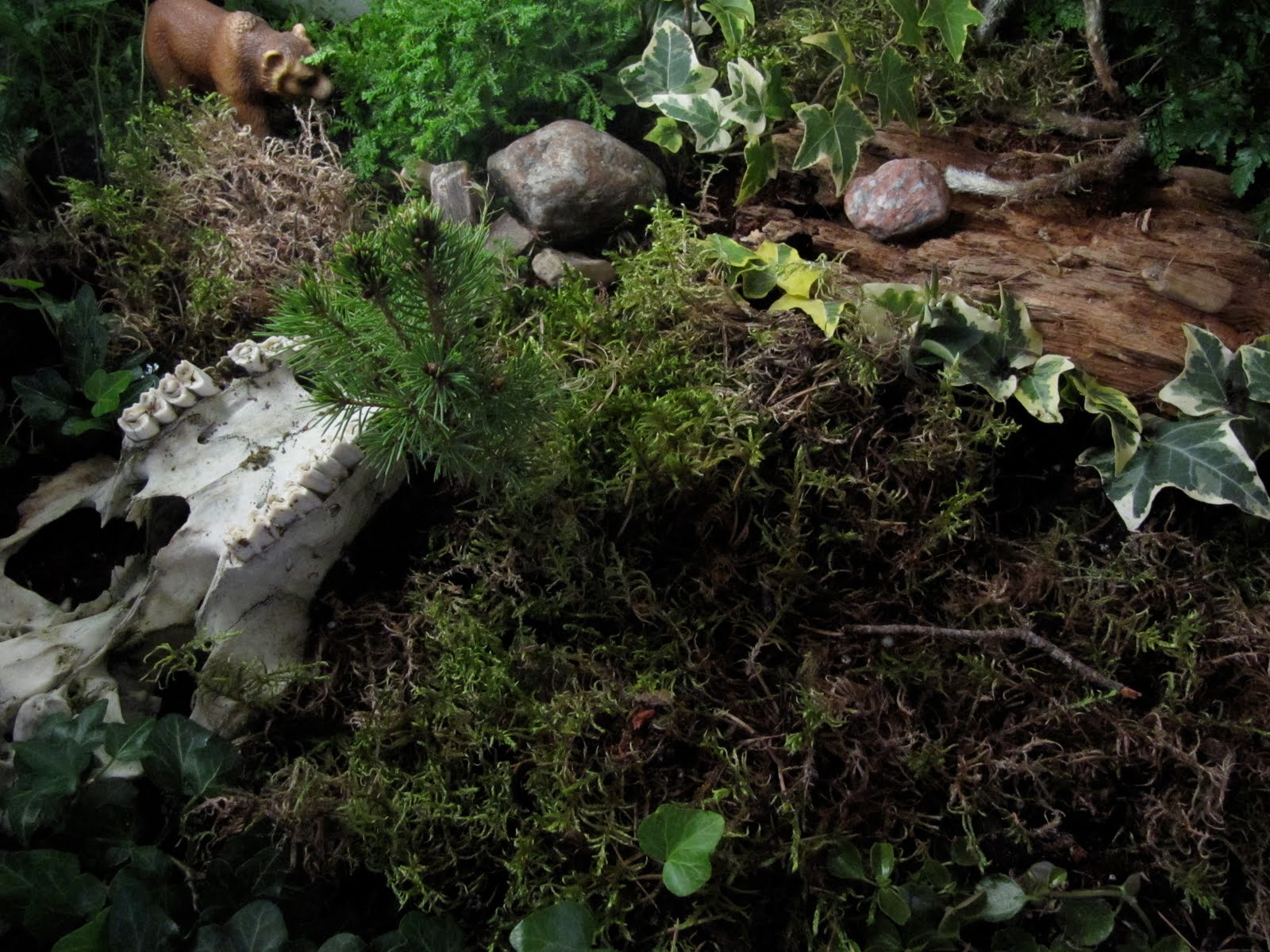
But what if you get a new terrarium and you're so impatient to see it green that you forego the research and footwork of transplanting part of your area's natural plants? Well, the terrariums pictured above are just a mishmash of semi-tropical plants chosen for similar light and water needs. The high-minded ideals of the gentleman naturalist have been forgotten for a while; I just wanted a healthy, awesome looking terrarium.
Sure, I think that some scientists would frown on miniaturizing a bear with a Shrink-O-Scope just to put him in a terrarium. But their stupid scientific ethics are preventing them from having some really cool terrariums.

Saturday, April 3, 2010

Bison Horn

I found this bison horn underground during a pipeline excavation on a low plain at the base of the Battle River watershed. Not too long after our work was finished in the valley another pipeline was being installed nearby. Work was halted there when workers discovered bison remains. An archeological survey team found evidence that the area was used as a bison run.
This Aboriginal hunting technique was similar to the more well known Buffalo Jumps, where hunters would force a bison herd to stampede through a V-shaped corral ending in a steep cliff. The bison would stream over the edge to an ever-growing pile of smashed meat. In the absence of a gorge, hunters would build the corral to end in a ring. Instead of harvesting the bison from a bloody assemblage at the base of the cliff these hunters would actually have to do the dangerous killing work.
This image has a hold on me. Huge beasts run shoulder to shoulder at full gallop down the hill, kept inside the ever-narrowing corral by fire and arrows. Thousands of steaming bison threaten to break through at any moment, trampling the tiny hunters. The terminus ring is an anarchic vision of bison Hell as the valley fills with smoke and the bellowing of the wounded and dying. Hunters with arrows and spears surround the circle, hoping desperately that the fires keep the powerful animals inside.
Think about that the next time you buy a cheeseburger and be thankful that the Europeans brought domesticated ungulates to North America. Because hunting bison sounds like a real bitch.