Sunday, April 4, 2010

Terrariums


The terrarium has long been a popular tool for naturalists. It allows you a great degree of control over a created environment, which is an ideal way to study an ecosystem. Monitoring changes in humidity, temperature and species interaction make it possible for a naturalist to gain insights into how these forces affect animals and plants in the wild.
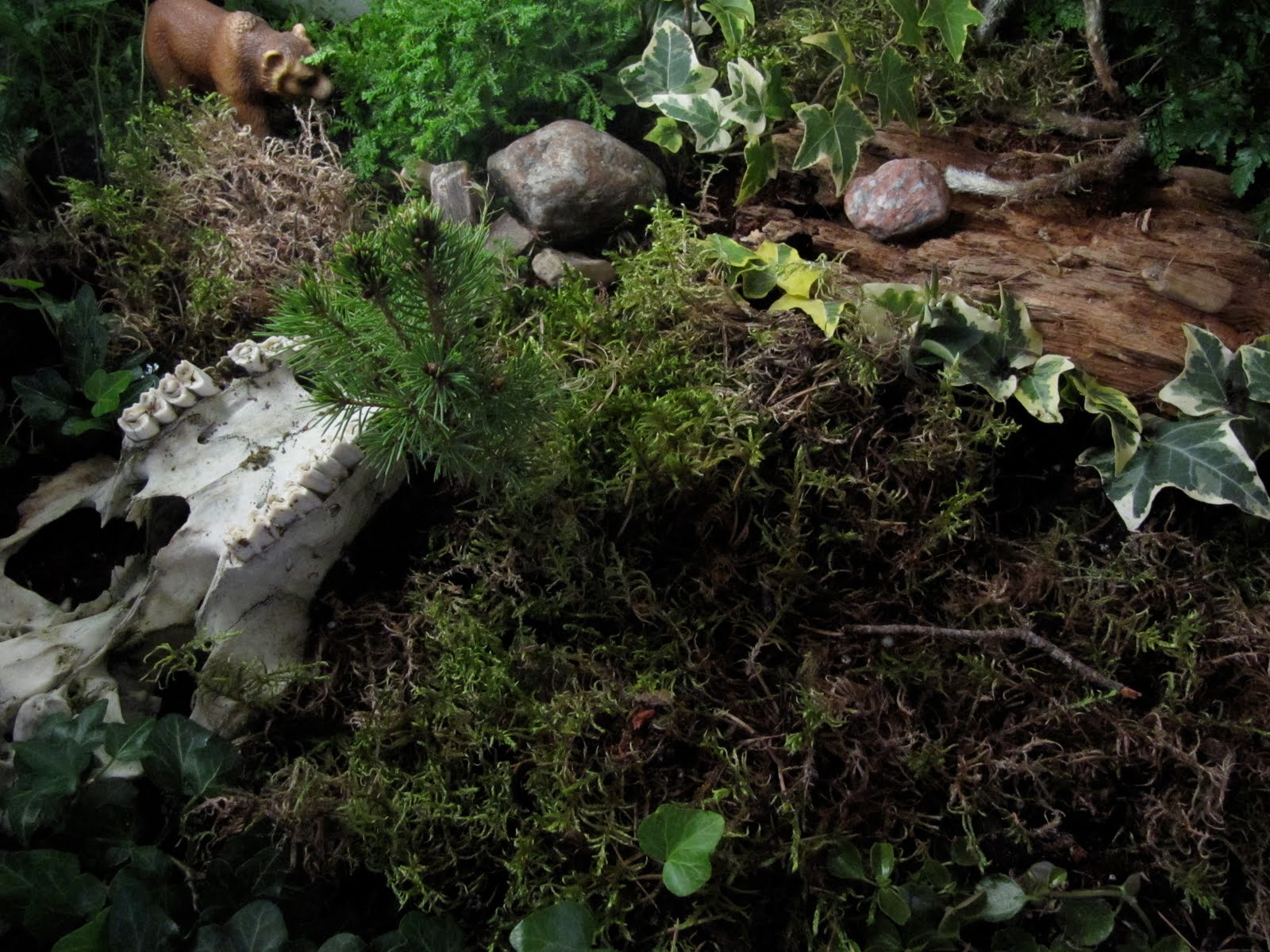
But what if you get a new terrarium and you're so impatient to see it green that you forego the research and footwork of transplanting part of your area's natural plants? Well, the terrariums pictured above are just a mishmash of semi-tropical plants chosen for similar light and water needs. The high-minded ideals of the gentleman naturalist have been forgotten for a while; I just wanted a healthy, awesome looking terrarium.
Sure, I think that some scientists would frown on miniaturizing a bear with a Shrink-O-Scope just to put him in a terrarium. But their stupid scientific ethics are preventing them from having some really cool terrariums.

Saturday, April 3, 2010

Bison Horn

I found this bison horn underground during a pipeline excavation on a low plain at the base of the Battle River watershed. Not too long after our work was finished in the valley another pipeline was being installed nearby. Work was halted there when workers discovered bison remains. An archeological survey team found evidence that the area was used as a bison run.
This Aboriginal hunting technique was similar to the more well known Buffalo Jumps, where hunters would force a bison herd to stampede through a V-shaped corral ending in a steep cliff. The bison would stream over the edge to an ever-growing pile of smashed meat. In the absence of a gorge, hunters would build the corral to end in a ring. Instead of harvesting the bison from a bloody assemblage at the base of the cliff these hunters would actually have to do the dangerous killing work.
This image has a hold on me. Huge beasts run shoulder to shoulder at full gallop down the hill, kept inside the ever-narrowing corral by fire and arrows. Thousands of steaming bison threaten to break through at any moment, trampling the tiny hunters. The terminus ring is an anarchic vision of bison Hell as the valley fills with smoke and the bellowing of the wounded and dying. Hunters with arrows and spears surround the circle, hoping desperately that the fires keep the powerful animals inside.
Think about that the next time you buy a cheeseburger and be thankful that the Europeans brought domesticated ungulates to North America. Because hunting bison sounds like a real bitch.

Friday, April 2, 2010

Swallow Nest

This swallow nest is from the underside of a bridge near Amisk, Alberta. There were dozens of the mud-daubed homes there. Most were out of reach but by climbing up and stretching out I could grab some of them. Seven or eight of the damned things broke off in my hands and I soon exhausted the easy possibilities. So I had to get serious about this nest collecting business. I went back to my truck and got a ratchet strap. I got myself strapped around one of the supports of the bridge, leaning precariously with hands free. I still failed to harvest a nest without breaking a few, showering myself with dirt and spider webs.
Then I felt a peculiar crawling feeling on my neck and face. I looked closer at the nearest intact nest. Parasites. Lots of them. Good God. And because I was stretched out over the Amisk Creek with just a looped ratchet strap giving me stability I couldn't do what instinct demanded I do; squirm around and flail my arms, try to brush the little vampires off me before they dug in for a blood meal. But I could whimper and curse, so I did.
I calmed down a little and decided that since I already had a bunch of filthy mites on me I might as well get what I came for. I managed to get two nests off, climb back down to ground. I set my fragile treasures down. Then I squirmed around, flailed my arms and tried to brush the little vampires off me before they dug in for a blood meal.
I called Wes on my way back to the truck. I left him a screaming message. "WES! I'VE GOT FUCKING PARASITES! AGAIN!"
He called me later. Yup, those are some swallow bugs you got there. Yup, they specialize on birds but will take a mammal if they can. Well, it's tough to say whether they'll stay with you and rear young. They kill a lot of young birds. Thanks, Wes.
The nest pictured above is a gift for my pal Darla. It is coated with plaster for strength and beauty. It is one of my favourite examples of animal architecture, along with the nests of the mud-dauber wasps which are fundamentally the same. I'm thinking about making casts of them so I can mass-produce replicas in plaster for home decoration.
Replicas I can produce in my home would be ideal, really. Because I don't want to get parasites again. It's getting old.

Tuesday, March 30, 2010

Tick and Young

This tick had in many ways an ideal life. She was one of the lucky ones clinging to a blade of grass that managed to latch on to a passing mammal. Secreted in the thick fur of a terrier, she gorged on blood. She was probably a few millimetres across when she began feeding. But when she was discovered by the dog's owner she had swollen to nearly an inch, engorged with the blood that she needed in order to give birth to thousands of live young.
So far, so good, Tick. But this tick was also the catalyst for one of the best practical jokes I've ever seen. My entomologist pal Wes Hunting worked in the Strickland Museum of Entomology while writing his Masters Thesis. Sometimes people would drop into the museum with weird bugs that they were distraught about, seeking information and reassurance from the experts. This tick was brought in by a worried woman who had found it on her pooch. Wes assured the lady that everything was fine, that her dog had been playing host to a blood-sucking parasite for a while and no, the tick hadn't yet hatched thousands of live young in her home. No big deal.
So Wes took the tick home with him that night. He showed it to our roommate Chris and told him in worried tones that he'd found it in his bedroom. Wes suggested that maybe Chris should check his bedroom too, y'know, just in case. When Chris found a blood-swollen tick beneath his pillow he lost control of himself in revulsion and terror. He made high strangled sounds in his throat. He started feeling phantom biting under his clothes. Wes did his best to calm him down, of course, and took the offending insect and 'flushed it down the toilet.' Chris had already starting tearing apart his bedroom, looking furtively in nooks, baring his teeth at shadows. Wes, ever the helpful friend, helped look for any other ticks. And, wouldn't you know it, he found one between Chris' sheets. And another, beneath his bed. This is about when I came home. Chris was wild-eyed and sweaty, carrying all of his belongings to the front lawn, throwing them in heaps, yelling curses. He blamed everyone for his disgusting misfortune; the landlord, our roommate John, our friend's dog, God, the Devil and even, for a brief moment, himself. It was only a case of beer later that he calmed down enough to learn who he should have been blaming all along.
The tick survived the entire ordeal with less damage than Chris did. She even lived long enough to birth a few thousand progeny. Then her and the little ones were dumped into a jar of alcohol so that they could one day decorate my apartment.

Word to the wise: Entomologists are devious and will play upon your fears for sport.

Sunday, March 28, 2010

Pigeon Skeleton

I found over a dozen of these well preserved pigeon skeletons in the downy insulation of an old CPR rail station. There were adults, juveniles and even a calcified unhatched egg up there in the attic. While I was very happy to have stumbled upon this trove of Things That Will Make Me More Attractive To Women (TTWMMMATW), the skeletons brought up some questions. Why did all these pigeons in various stages of their development die here in peaceful poses? What contributed to their remarkable preservation? Why does it all make me so sad?
Well, I didn't get all CSI about it, but I did ponder a bit. I think it's likely that this group of pigeons fell victim to parasites. Predators seem to be out of the question, as none of the skeletons were ripped apart. There are a number of mites that prey on birds, for example, and while I think healthy adults can withstand external parasites pretty well, juveniles often don't make it out of the nest if there are too many blood-suckers growing fat on them. As for the preservation (often the ligaments are still attached) it might be attributed to the even temperature and dryness up in the attic. And the sadness was just an Internet pose of mine. I have never felt sad about these pigeons.
So: Pigeons have died, I am not sad about it, I don't know why they died and I don't know how many pigeon ambitions died with them. But I am glad that I own more pigeon skeletons than my Dad did at my age.

Thursday, March 25, 2010

Bug-Sucker

I call this little darling a Bug-Sucker. Most people call it a "pooter." I was introduced to it by Wes Hunting, an entomologist and friend. (I recognized the basic design from my homemade bong days.) The concept is simple; you suck one end, create a vacuum in the chamber, bugs are sucked into the chamber through the other tube. This machine is easily made in the home and is a great way to collect bugs that are less than pleasant to handle.
It is not without its drawbacks, though. If you fail to put some screen on the inside of the suction end you are liable to be chewing on some insects. And since so many insects have chemical defenses, you are almost assured a whiff of some of the following: steroids, alkaloids, cantharidin, hydrogen cyanide, histamine, or acetylcholine. Wes Hunting actually likes the smell of many defensive chemicals, and he taught me to enjoy most of them, too. The bug-sucker design has actually helped me to catch ants by using their panic pheromones against them. I collect a bunch of ants into the chamber, totally stirred up and positively reeking of panic and aggression.Then I blow gently, aiming the tube at another entrance to the anthill. The pheromones travel and lure more and more ants straight to the business end of the bug-sucker.
TOTALLY TRUE FACT THAT IS FUCKED RIGHT UP:
There are documented cases of entomologists using bug-suckers and inadvertently allowing their mucous membranes to host eggs to a larval state.
Wait. Was I unclear about that? Let me try again.
BUGS WILL ACTUALLY FUCKING HATCH IN YOUR THROAT AND NOSE IF YOU USE THESE FUCKING THINGS!

Wednesday, March 24, 2010

Tree Fungus

This fungus can be found anywhere there is sufficient moisture and shade to encourage rot in deciduous trees. It goes by a number of names including Artist's Bracket, Artist's Conk, and this is surely my favourite; Flacher Lackporling.
Apparently there are artists that enjoy using the Flacher Lackporling and related fungi as their drawing medium. They mark the bracket fungus with something sharp, establishing lines and shading on the surface. This strikes me as being presumptuous. Is this another example of artists refusing to let beauty exist for itself?
What could their scratchings present to the world that this fungus hasn't already unobtrusively shown? It has graceful lines, careful tones and beautiful textures. It has a perfect visual harmony with the context in which it exists. This fungus is a masterpiece. It requires no intervention to make its beauty known.

FLACHER LACHPORLING
- 1 GODDAMNED ARTISTS- 0